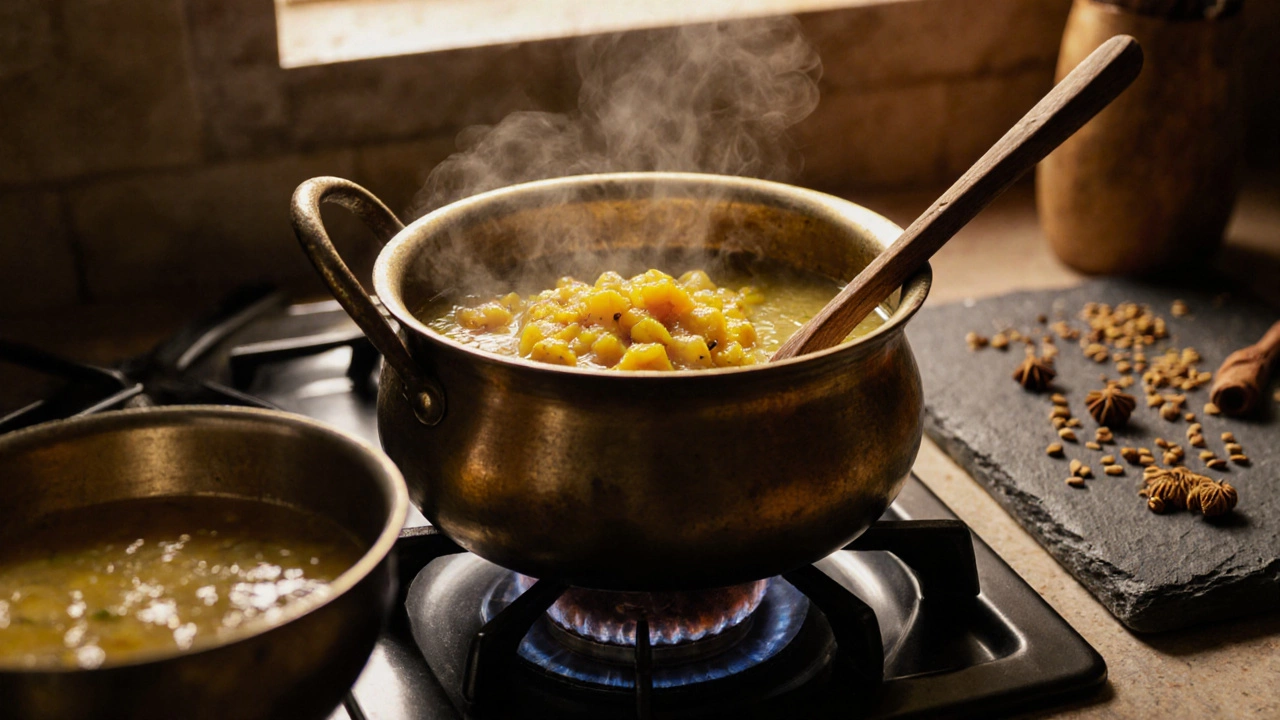
Lentil Water Ratio: How Much Water You Really Need for Perfect Dal
When you cook lentil water ratio, the proportion of water to lentils that determines whether your dal turns out creamy or watery, thick or soupy. It's not just a number—it’s the difference between a comforting bowl of dal and a disappointing one. Too little water and your lentils stay hard. Too much and you end up with bland, runny soup. The truth? There’s no single perfect ratio for every type of dal. It depends on the lentil, whether you soaked it, and what texture you want.
Moong dal, a small, yellow lentil that cooks fast and breaks down easily, needs about 2 to 2.5 cups of water per cup of lentils. Toor dal, the sturdy, beige lentil used in sambar, wants closer to 3 to 3.5 cups because it holds its shape longer. Chana dal, split chickpeas that stay firm even after cooking, often needs even more—up to 4 cups—especially if you didn’t soak it overnight. And if you’re making dal for kids or elders who prefer smooth texture? Add more water. For a thick, spoonable dal? Cut back.
Soaking changes everything. Unsoaked lentils absorb water slowly, so you need to start with more. Soaked ones swell up first, so you can use less water and still get creamy results. That’s why many Indian kitchens skip soaking but compensate with extra water and longer simmering. But if you’re short on time, soaking for just 30 minutes cuts cooking time and helps you control the water better. It also reduces gas—something you’ll notice if you’ve ever had bloating after a big bowl of dal.
And don’t forget the pot. A pressure cooker traps steam, so you need less water than when cooking on the stovetop. On the stove, water evaporates, so you might need to add a splash later. In a slow cooker? You can go even lower because the lid stays sealed. The lentil water ratio isn’t fixed—it’s a tool you adjust based on your method, your lentil, and your taste.
You’ll find posts here that break down exactly how much water to use for each common dal, whether you’re using a pot, pressure cooker, or Instant Pot. Some explain why rinsing matters before you even add water. Others show how to fix watery dal after it’s cooked. And a few reveal the tricks chefs use to make dal taste richer without adding cream or butter—just by controlling the water and simmer time. Whether you’re new to cooking dal or you’ve been making it for years, the right water ratio is the quiet hero behind every great bowl.